
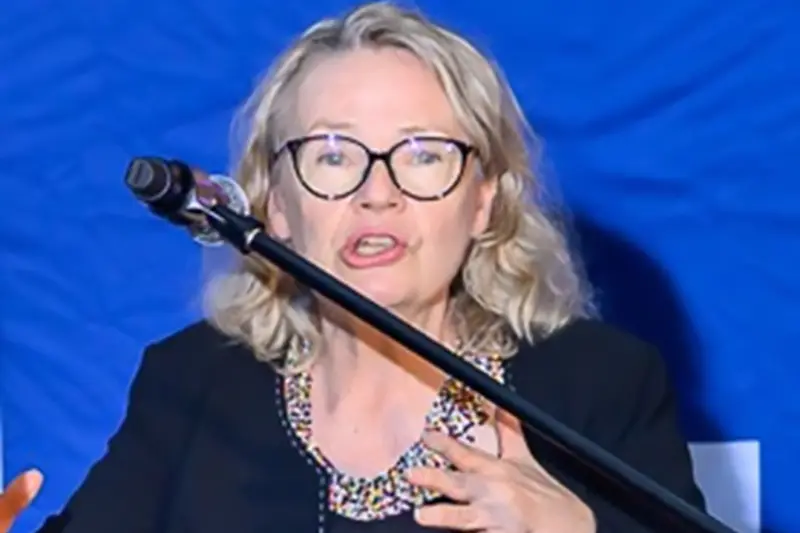
“Africa is the continent where the big challenges facing the world will be solved. This is also the continent where the destiny of humankind will be resolved as the Global North has pretty much dropped the ball.”
This was the message from Finnish-born Ms Jaana Puukka, founder and director of Innovation Engage, a consulting firm which advises European organisations, governments and institutions in the higher education sector on policy, strategy and evaluation, when addressing attendees at the recent official launch of the Mr Price Foundation x EDHE Waste Innovation Challenge.
This is a new national competition that challenges South African university students, alumni and researchers to reimagine plastic waste as an engine for green entrepreneurship and is co-hosted by Mr Price Foundation and Universities South Africa’s Entrepreneurship Development in Higher Education (EDHE) programme.

She praised the progress made by the Innobiz Durban University of Technology (DUT) Centre for Entrepreneurship and Innovation which serves as the umbrella body for all DUT entrepreneurial units offering both theoretical and technical entrepreneurial learning, business support, and related activities. These include a Tech Hub, Agri Hub, Innovation Hub and Art Hub.
“I am delighted to see how Innobiz has grown from a humble start into a fine centre with strong collaborations with a number of important stakeholders. It is wonderful to see a continent and a country with young people who have ideas, drive and hope for the future.”
Ms Puukka said her first collaboration with South Africa started in 2010 when she led an Organisation for Economic Co-operation and Development (OECD) review in the Free State that examined the role of higher education institutions in regional and city development. The OECD is an intergovernmental forum of 38 member countries, established in 1961, dedicated to promoting policies that improve economic and social well-being worldwide.
Waste can be a valuable commodity
“One of the conclusions was that higher education institutions need to collaborate and I am delighted that the four universities in the KZN region – DUT, the Mangosuthu University of Technology, the University of KwaZulu Natal (UKZN) and the University of Zululand, all of which fall under the USAf umbrella – are here today. I encourage you to pool resources and work together not only with this challenge but with all opportunities where you can work in partnership.”
Waste, she said, was a valuable commodity, referencing Sweden, which has developed one of the world’s most effective and advanced waste management systems, achieving a “circular economy” model where less than 1% of household waste ends up in landfills. Because its recycling and waste-to-energy conversion systems are so efficient, Sweden does not generate enough waste to keep its 34 waste-to-energy (WtE) plants running at full capacity and, as a result, has to import annually approximately 1.3 to 2 million tons of waste from countries such as the UK, Norway, Italy and Ireland.
This was something South Africa could learn from.
“Solving this problem is very important and it will benefit from deep collaboration between the higher education institutions and various stakeholders. It is about teaching and learning, research and innovation, entrepreneurship and starting up new businesses. It is also about community development. Too often, in some countries, you see the attitude where littering and the throwing away of waste is seen as something that you do because it creates jobs. But what kind of jobs does that create? They are low skilled, non-beneficial jobs. You need to climb up the ladder. You need to incentivise by, for example, giving back some money if bottles are returned. I firmly believe that South Africa will be able to solve its waste problem and, with initiatives such as the Mr Price Foundation x EDHE Waste Innovation Challenge, there will be a visible difference and thriving communities.”
This was a sentiment echoed by Dr Pinkie Ntola, interim director of Technology Transfer and Innovation at DUT.
“Waste is one of the biggest environmental issues plaguing our planet and it is up to us to find innovative solutions to these problems. DUT’s identity is deeply rooted in innovation with impact. As a university of technology, we exist at the intersect of knowledge creation, practical solutions and some societal transformation. The Waste Innovation Challenge speaks directly to that mission.”

A call to action
She said that waste wasn’t simply an environmental concern but a socio-economic one that demands bold thinking, cross-sector collaboration and solutions that are inclusive, scalable and sustainable.
“This is an opportunity that we can use to innovate for entrepreneurship and green economic growth. It is a platform that empowers innovators to develop solutions that respond to real-world challenges and also demonstrates how private and public sector partnerships can play a catalytic role in building an innovation ecosystem that responds to national priorities and community needs,” she said.
“At DUT we’re committed to advancing solutions that contribute to the circular economy and environmental resilience. Equally important is the role our students and emerging innovators can play. Such competitions as these provide them with the opportunity to move beyond theory to actually test ideas, build prototypes and create enterprises that have a real and tangible impact. This is how we measure the next generation of problem solvers and change makers in our society. Today’s launch is therefore more than just an event, it’s a call to action and an invitation to collaborate across disciplines, institutions and across sectors.”
The Mr Price Foundation x EDHE Waste Innovation Challenge is open to all university students, alumni and researchers, aged between 16 and 34 years who hold a South African identity number and who come from one of South Africa’s 26 public universities. Those interested can enter as individuals or as a team of up to four members. The challenge is focused on environmental impact, particularly in plastic waste management, green technologies and circular economy ventures. Entries close on February 27 this year.
Janine Greenleaf Walker is a contract writer for Universities South Africa.