
When a group of South African academics submitted their teaching case studies to a national competition run by the Entrepreneurship Development in Higher Education (EDHE) programme team, most were not thinking about a book. They were thinking about a problem, a stubborn and specific challenge within their own classroom, department or community, and what they had done to address it.

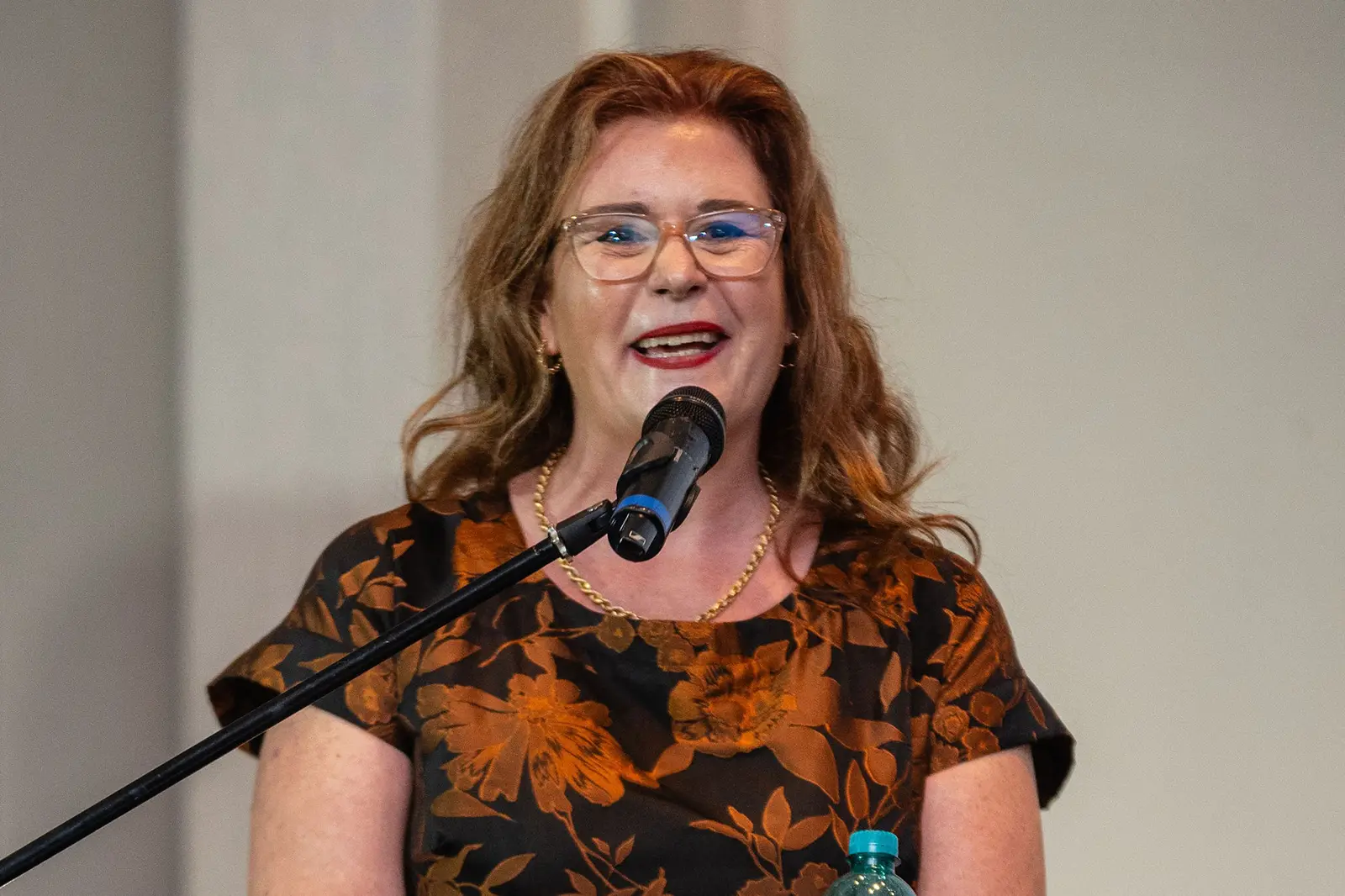
Professor Thea van der Westhuizen (left), Associate Professor and Academic Leader for High Impact Community Engagement and Internationalisation at the University of KwaZulu-Natal, who served as the editor and contributing author, reflected at the launch, “The ultimate goal is to bridge between theoretical ideas and real-world realities.”
At the launch of Innovative Pedagogies for Entrepreneurship Education: Insights and Reflections from South Africa, held on 26 March 2026 on the East Rand, outside Johannesburg, academics, students, university leaders and government officials gathered around this central idea.
The book came later
What the 23 authors brought to the book’s pages was something harder to manufacture than scholarship: evidence from real teaching and learning contexts.
As reflected during the session, “Pedagogy is the art and science of teaching,” a point emphasised by Dr McEdward Murimbika, Director of the Wits Centre for Entrepreneurship and New Venture Creation, and Deputy Chairperson of the national EDHE Community of Practice for Entrepreneurship Learning and Teaching. In the context of entrepreneurship, this relationship becomes more complex, requiring educators to move beyond theory and into lived practice.
At the launch event, six of the 23 contributing authors were invited to the stage to describe their chapters. What emerged was a series of grounded reflections from educators working at the intersection of teaching, practice and community engagement.
Taking the university into the community
Dr Thulile Promise Mofokeng (right), lecturer in the Department of Entrepreneurial Studies and Management at the Durban University of Technology (DUT), said she did not set out to write a book chapter. She was collecting data for her PhD in a rural area of KwaZulu-Natal when, as she put it, “being a teacher immediately kicked in. I’m not just a PhD candidate, I’m also a teacher,” she told the audience. She said she thought then: “How can I use this to involve my students and colleagues and see how we can uplift this amazing community?”
The project took shape in Ngodini, a village anchored by a recreational hub offering hiking, quad biking and adventure tourism, surrounded by smaller businesses that had not fully capitalised on the opportunity this foot traffic presented.
She returned to the Durban University of Technology and brought together colleagues and students across disciplines, including entrepreneurial studies, ecotourism and horticulture, to respond to the challenge collaboratively. “Let us collaborate,” she said, describing how the project drew together different areas of expertise to support the community.
Students worked directly with local entrepreneurs, providing training and mentorship. “We trained about 25 entrepreneurs,” she explained, “and they were all given accredited certificates to make sure they can access funding.”
Alongside this, ecotourism and horticulture students focused on environmental stewardship, installing visitor signage and working with local communities to incorporate indigenous knowledge into tourism offerings. The impact has been tangible. A permanent community market now operates in the area as a direct outcome of the project.
Already thinking ahead, Dr Mofokeng added: “The plan is to expand the project’s geographical footprint. We started with one community. Why not multiple communities?” At the heart of the challenge, she noted, is not starting businesses, but sustaining them. “We don’t have a problem with starting businesses,” she said. “The issue is sustainability.”
From robot to innovator: entrepreneurship in the medical laboratory
Ms Nokukhanya Thembane (left), Senior Lecturer in the Department of Biomedical Sciences at Mangosuthu University of Technology (MUT) and a qualified medical laboratory scientist, opened her reflection with a blunt assessment of the current state of scientific training. “Our students are good technical scientists — in a way, robots,” she said. “They don’t have an innovative mindset.” The consequence, she argued, is a missed opportunity. “Our universities keep producing graduates who are smart, but cannot formulate a product.”
Ms Thembane described how this gap became particularly visible during the CoViD-19 pandemic, when South Africa was importing products such as N95 masks and medical gloves, items that local graduates had the potential to design and manufacture.
Her response was to embed entrepreneurial thinking into the medical laboratory science curriculum, starting at the fourth-year level and now extending across all years of study. “We are not teaching people to be supervisors,” she said. “We are teaching people to say: instead of going to work for Lancet Laboratories, why don’t I have my own laboratory?”
The approach has already begun to yield results. Students are working with the university’s Technology Transfer Office to develop prototypes, with early signs of potential commercialisation.
The hospitality kitchen as a business school
For Ms Nokuthula Seabi (right), a Lecturer in the Department of Consumer Sciences of the University of Zululand, entrepreneurship education begins with reframing what her discipline represents.
“One may think hospitality is cooking,” she said. “However, with this project, we motivate students to be problem solvers. We encourage them to look beyond the cooking and solve problems within their communities.”
Her project, embedded in a final-year Honours module, requires students to move through a structured process, from business concept development and planning to pitching and ultimately operating a real enterprise.
“The students run an actual business and generate profit in the process,” she explained. The model is intentionally experiential. Students compete, collaborate, and ultimately run a functioning business, managing operations, finances and staffing where necessary. Beyond technical skills, the project develops independence and critical thinking, giving students a practical space to test ideas and learn from failure before entering the industry.
Design Thinking at scale: postgraduate students as problem-solvers
Mr Kagiso Mashego (left) is a lecturer in the Department of Business Management at the University of South Africa (UNISA). His work begins with a problem that has become increasingly visible across the sector: qualified graduates who remain unemployed.
“When we were doing our research, we identified a lot of people who were graduates but were still unemployed,” he said. “That was really painful. We needed to do something about it.” His response was to redesign a postgraduate research module around community-based design thinking.
Students, working remotely from different parts of the country, “go into their community, identify a problem, come back and discuss it, go back and validate that idea,” he explained. The process culminates in a business pitch, with selected ideas receiving further support through an external innovation hub. The results are already visible. Some students have taken their ideas beyond the classroom, developing functioning businesses rooted in real-world challenges.
Empathy first: rethinking where entrepreneurship begins
For Mrs Onica Thandi Matsheke (left), a Lecturer at the Vaal University of Technology, the starting point of entrepreneurship is not the idea; it is the problem. “How can you start a business without knowing a problem? How can you start a business without understanding a real need?” she asked.
Her approach places significant emphasis on the empathy phase of design thinking. Students are required to engage extensively with potential users before defining a problem or proposing a solution. “Students must first empathise with people, understand their problems, and only then develop solutions,” she explained.
This grounding in lived experience allows students to build more viable and relevant business models, often aligned with broader societal challenges such as the Sustainable Development Goals. The outcomes extend beyond the classroom. “I have students who have already started their businesses,” she said, “not as a class exercise, but as real enterprises generating income.”
Rethinking the classroom: teaching entrepreneurship within constraints
Offering a more reflective perspective on teaching practice, Ms Vhuhwavho Tshavhungwe (left), a lecturer from the University of Venda, spoke about the realities of introducing entrepreneurship into the classroom, particularly within institutions navigating resource constraints and evolving mandates.
Having joined academia recently, she reflected on the expectations placed on universities to produce graduates who are able to respond to challenges such as unemployment, while at the same time positioning themselves as entrepreneurial institutions. The question, she suggested, is not simply whether entrepreneurship should be taught, but how it can be meaningfully integrated into everyday teaching practice.
In her own classroom, this has meant rethinking how students engage with their work. Rather than relying on traditional group assignments, Tshavhungwe has shifted towards more individualised tasks that encourage independent thinking and accountability. “I didn’t want them to sit in groups and copy from each other,” she said, explaining her decision to structure assignments in a way that required each student to develop their own ideas and responses.
This approach, she explained, is also about encouraging students to see their academic work as something that can extend beyond the classroom. By grounding assignments in real-world relevance, students are prompted to think more critically about how their ideas could translate into practical outcomes. “Sometimes, as educators, we need to be creative and challenge ourselves, and also challenge our students,” she added.
A model for the world built in South Africa
The final chapter of the book departs from individual case studies to describe what the editors present as a coordinated South African model of entrepreneurship education. Rather than treating classrooms, communities and institutions as separate spaces, the model brings them together into a single, integrated ecosystem, one in which students are not only learning about entrepreneurship but actively participating in it.
Across the case studies, a clear pattern emerges: students are not simply completing assignments, but building businesses, testing ideas, and engaging directly with the challenges of their communities.
What this book demonstrates is that those models already exist, shaped by local realities, tested in real classrooms, and grounded in the lived experiences of both educators and students.
Thoriso Kolobe is a Digital Communication Consultant commissioned by Universities South Africa.