
What does it take to build a society where young people can create, adapt and respond to uncertainty with confidence? According to the Entrepreneurship Development in Higher Education (EDHE) programme, the answer begins in the classroom, and with the teachers who lead it.
From 9 to 11 June 2026, EDHE, an initiative of Universities South Africa (USAf), brought together university faculty from schools of education, government officials, private sector representatives and entrepreneurship education practitioners at The Centurion Hotel in Pretoria for a three-day train-the-trainer workshop. The gathering explored a question that sits at the heart of South Africa’s education and economic future: how can entrepreneurial competencies be embedded into teacher education, and through teachers, into the basic education system itself?
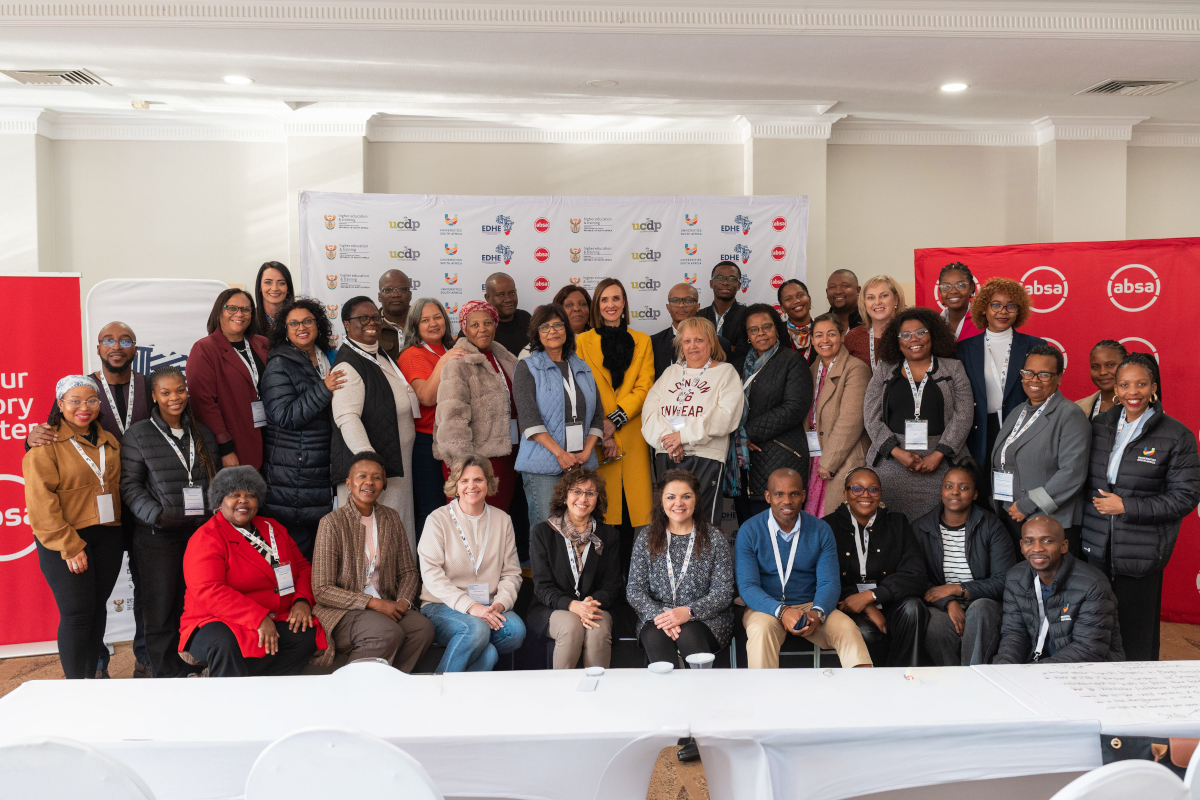
Attendees of the workshop
Rethinking what entrepreneurship means
A recurring theme throughout the workshop was the need to move beyond narrow definitions of entrepreneurship. Rather than associating it solely with starting a business, participants were invited to understand entrepreneurship as a broader human capability, encompassing the ability to identify opportunities, respond to uncertainty, solve problems, create value and contribute meaningfully to society.

Dr Edwell Gumbo, Director: Entrepreneurship Development in Higher Education (Left), set this tone early. “We are not saying everyone should be an entrepreneur, but what we are suggesting is that every young person should be equipped with the ability to create value, to act on opportunities, and to navigate uncertainty with confidence,” he said in his opening remarks. Whether a learner goes on to become a teacher, engineer, doctor, scientist, public servant, artist or entrepreneur, Dr Gumbo noted, these competencies remain relevant and valuable throughout life.
Mr Setlogelo Manchidi, Managing Executive: Corporate Citizenship at Absa (Right), echoed this view from the private sector perspective. “For a long time we have defined it very narrowly, merely limited to just starting a business. But really, while starting a business is important, it is only part of a bigger story. At its core, entrepreneurship is a mindset.” This mindset, he said, shows up in everyday moments: when a learner tackles a difficult challenge with confidence, when a teacher finds a new way to engage a class, or when a community member develops a practical solution to a localised problem. “This would be entrepreneurship, not as defined by business books, but entrepreneurship in action.”
Why teachers are the starting point
The workshop’s focus on faculties and schools of education was deliberate. Teachers occupy one of the most influential positions in any society, shaping how learners think, respond to challenges and understand their own potential. Every future entrepreneur, innovator, researcher and university leader spends years under the guidance of a teacher.
“If we want entrepreneurial learners, we need entrepreneurial teachers,” Dr Gumbo said. Rather than advocating for isolated interventions, he made the case for systemic change, arguing that embedding entrepreneurial competencies within pre-service teacher education is an investment in the future of an entire education system. The scale of that investment is significant. “Every teacher prepared through our universities has the potential to influence hundreds and thousands of young people. The multiplier effect is therefore extraordinary.”
Policy, partnerships and the road ahead
The Department of Higher Education and Training (DHET) affirmed entrepreneurship education as a strategic priority for the sector. Ms Mandisa Cakwe, Director: University Capacity Development at DHET, noted that higher education institutions are increasingly expected not only to produce graduates with disciplinary knowledge, but to cultivate entrepreneurial capabilities, innovation, adaptability and problem-solving skills that respond to broader societal and economic challenges.
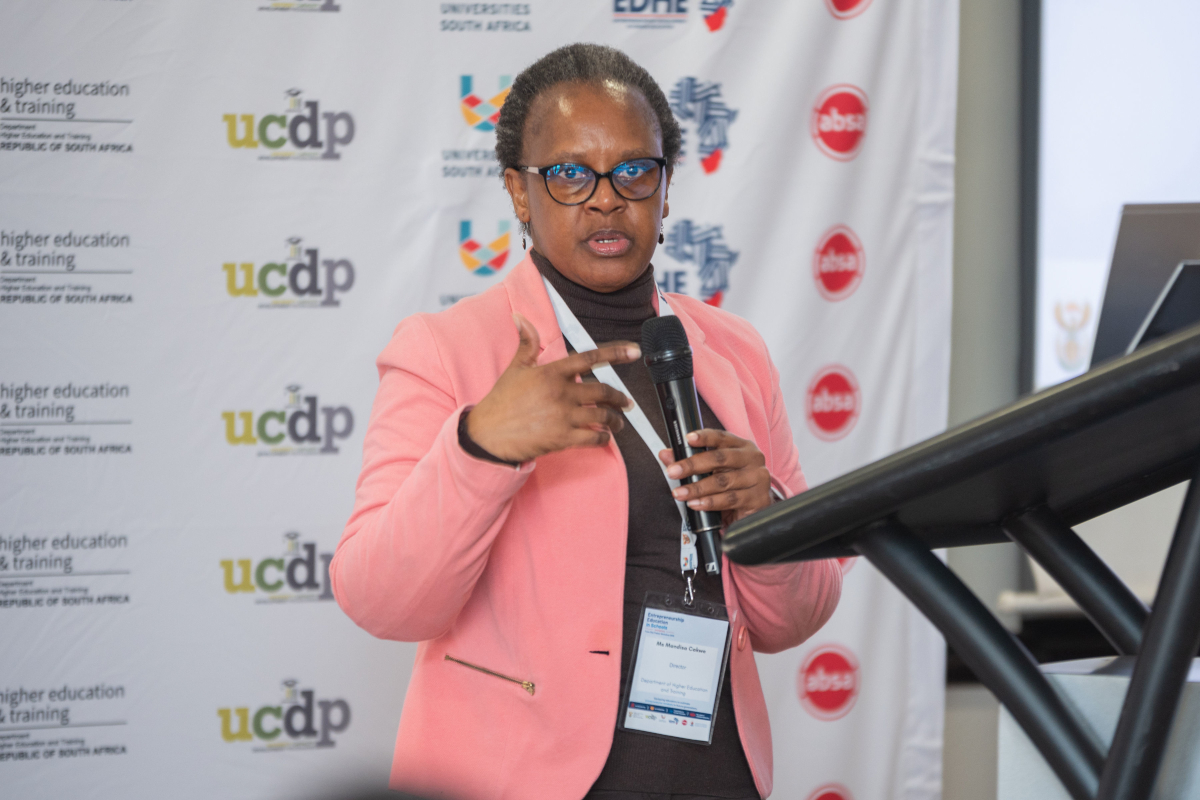
Ms Mandisa Cakwe, Director: University Capacity Development at DHET
“It is therefore essential that entrepreneurship in its broadest sense is fully integrated within the higher education sector as a strategic and policy priority,” Ms Cakwe said. She stressed that this integration must extend across teaching and learning, research, innovation, community engagement and institutional planning, and that enabling policy environments are critical to making it stick.
Looking ahead, Ms Cakwe referenced the development of new University Capacity Development Programme plans beginning in 2027 as an opportunity to test new approaches in teacher training, including the infusion of entrepreneurship into teacher education programmes. She also positioned faculties of education as central to driving this work at an institutional level: “Your leadership is essential in integrating entrepreneurship into teaching, learning, research and community engagement activities.”
Mr Manchidi was equally clear that no single institution can carry this responsibility alone. “No single university can do it on its own. Nor government itself can do it on its own.” Meaningful change, he said, requires ecosystems where education, government, business and communities each play a part, and demands a commitment to long-term investment. “The impact is not and may not always be immediate. But if we get it right, it is deep and it has a chance to be long-lasting.”
A conversation that reaches further
This workshop is part of EDHE’s ongoing effort to strengthen entrepreneurship development across South Africa’s public universities, but its significance extends beyond the university sector. By focusing on teacher education, the programme is working to reach learners at an earlier stage of their educational journey, building entrepreneurial thinking into the foundation rather than adding it on later.
In a country grappling with high unemployment, inequality and slow economic growth, that foundation matters. South Africa needs graduates who can create opportunities, not only seek them. And it needs teachers who can inspire that possibility from the very beginning.